
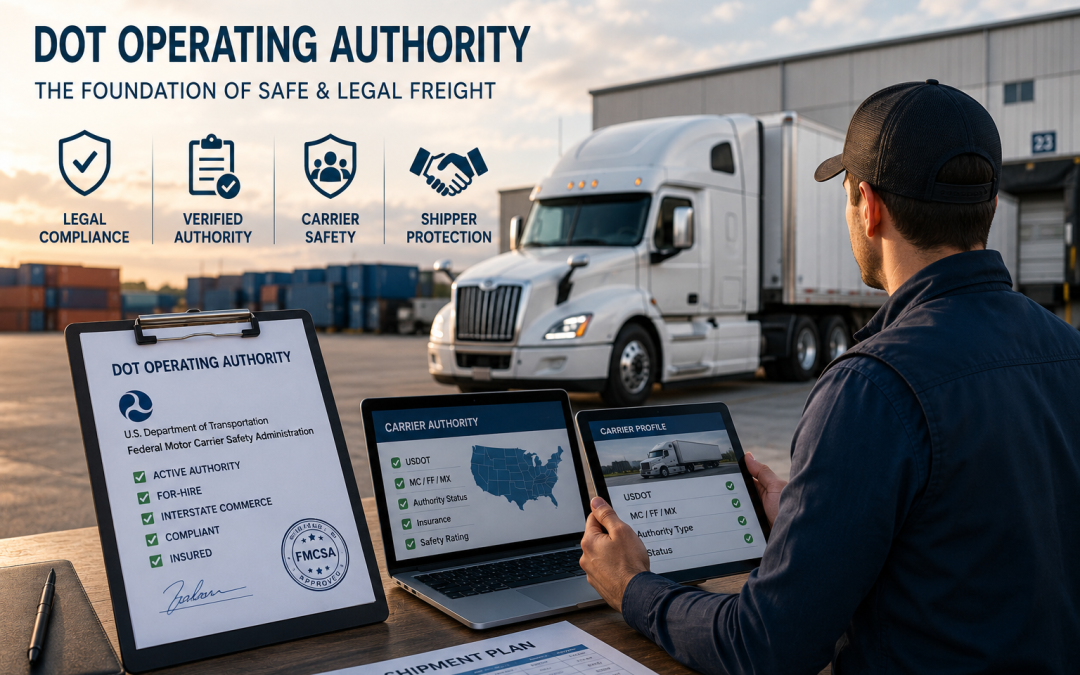
When you’re selecting a freight broker, the term “DOT operating authority” may sound like regulatory detail you can skip. In fact it’s foundational. Understanding authority helps you choose a logistics partner who can legally, safely and transparently move your freight.
What is DOT Operating Authority?
For shippers moving freight across state lines, working with brokers and carriers that hold the correct authority is not optional. Operating authority is the legal permission granted by the Federal Motor Carrier Safety Administration (FMCSA) that says a company may move goods (or arrange those moves) for-hire in interstate commerce. LegalClarity+2US Law Explained+2
Distinguishing USDOT vs MC/FF/MX numbers
Every for-hire motor carrier gets a USDOT number to track safety data. But having a USDOT doesn’t automatically mean the company has the right “operating authority”. That is tied to an MC (motor carrier), FF (freight forwarder) or MX (Mexico-based) number that tells you what and how they are allowed to operate. Authority Express
Why it matters to shippers and carriers
If a broker or carrier lacks the correct authority you risk service interruptions, invalid insurance claims, and regulatory fines. According to FMCSA guidance, if the operation is “for-hire” and interstate, authority is required. fmcsa.dot.gov+1
Types of operating authority (common, contract, broker, forwarder)
- Common carrier authority: moving regulated freight for the general public under published rates.
- Contract carrier authority: moving freight only for specific shippers under contract.
- Broker authority: arranging transport of property for others via authorised motor carriers, without taking physical possession. fmcsa.dot.gov
- Freight forwarder authority: consolidating shipments and taking responsibility for transportation.
- Selecting the right class of authority ensures your broker or carrier model aligns with your service and legal needs.
How Operating Authority Ties into Freight Broker Selection
What shippers should check (authority status, insurance, safety)
When you vet a freight broker, confirm they display their MC/FF number, prove their surety bond (for brokers typically $75,000) or trust fund, and show that the underlying carriers they use hold valid authority and safety records. DOT Compliance Group+1
Why working with a transparent freight brokerage matters
At 1FR8.Broker we believe transparency isn’t optional. We disclose full carrier names, rates, accessorials, and service metrics so you know exactly what you’re buying. If a broker hides the carrier or pads the spread, you can rarely hold the provider accountable. “We disclose carrier names and rates so shippers see the full picture.”
Real-world example: FTL lane with a vetted asset-fleet vs unknown carrier
Imagine you have an FTL lane Chicago→Atlanta. You contract with a broker that says “we’ll allocate our asset trucks”. Because they hold carrier name disclosure, you know fleet X with 50 tractors is assigned; you can integrate them into your route-guide scoring and safety reviews. With an unknown carrier, you risk delays, lack of visibility and hidden accessorials.
Key Questions Around Cost, Margins and Service When Authority Is in Place
Low fixed margin model vs hidden spreads
Many brokers make money by taking a hidden spread between the carrier rate and what the shipper is charged. That creates a conflict: the broker may be incentivised to choose a higher-rate carrier or cut service to widen the spread. At 1FR8.Broker we use a low fixed margin model. “Low fixed margin removes the incentive to play the spread.”
Carrier name disclosure – what shippers gain
When you know the actual carrier moving your freight you can: hold them accountable for on-time delivery, track specific lanes via scorecards, ensure their safety rating is satisfactory, and avoid being a backup plan if your broker changes carriers without notification. “When you know your carrier, you can hold them accountable for on-time delivery and detention performance.”
Accessorial transparency, detention, and on-time performance
Operating authority is just the baseline. Service quality comes from how the freight is handled. Transparent accessorials (detention, lay-overs, live-load/ unload burden) protect you from surprise cost escalations. Authority plus transparency = service you can measure.
Building Stable Procurement and Carrier Sourcing via Route-Guide and Authority Alignment
Contract vs spot freight – how authority & carrier sourcing drive stability
Spot freight is useful for flexibility, but leads to volatility in rate and service. If you build a route-guide of contract lanes with asset-based carriers (or long-term vetted carriers) whose authority and contracts are aligned, you get stable pricing and service. The broker’s role: vet carriers, secure authority-compliance, manage performance.
Drop trailer programs, dedicated lanes and how authority ensures continuity
For dedicated lanes or drop trailer programs you need carriers with stable models, relevant authority, and mutual trust. For example, you could have a drop trailer at a manufacturing site loaded daily and pulled nightly by a vetted fleet. Because the carrier holds authority for that operation and the broker discloses name and rate, your KPI for on-time pickup is measurable and trusted.
Scorecards, safety, vetting asset fleets – making authority work for you
Authority verification is only step one. The broker should provide carrier scorecards (on-time %, claims ratio, detention/lay-over metrics, safety rating). Shippers should demand this. At 1FR8.Broker we vet our asset fleets and provide performance data as part of our sourcing program.
Practical Checklist for Shippers Working with a Freight Broker
Ask to verify authority and safety records
- Verify broker MC/FF number and surety bond/trust fund.
- Ask for carrier USDOT & MC numbers.
- Check carrier safety rating via FMCSA licensing and insurance website. fmcsa.dot.gov+1
- Ensure carrier’s insurance is current and covers the lane you need.
Ensure carrier sourcing practices and no back-solicitation trap
- Ask: does the broker allow the carrier to bypass the broker and deal directly with you? If yes, you may lose procurement leverage or transparency.
- Conversation rewrite: “The broker must guarantee there is no unauthorized back-solicitation so your contracted spend remains protected.”
Request full transparency: carrier names, accessorials, rate stability
- Get the actual carrier name on each leg or lane.
- Ask for all accessorials in writing (detention, live-load/unload, temperature control, securement, lay-over).
- Demand clarity on how the margin is applied and confirm it is a fixed margin.
- Ensure annual review of lanes and carriers, aligned with your procurement strategy.
Why 1FR8.Broker Stands Out
Low fixed margin + full carrier disclosure
At 1FR8.Broker we charge a fixed pre-agreed margin on freight instead of hiding spreads. You know the cost up front and you know the carrier name. This aligns our incentives with yours: you get the best service at a clear cost.
Vetted asset fleets for FTL/LTL/reefer/flatbed
We maintain a network of asset-based carriers across equipment types: dry van, reefer, flatbed, dedicated lanes, drop trailer. Each is vetted for authority, safety, performance and reliability. We integrate them into your route-guide for transparency and continuity.
No back-solicitation, full route-guide support, stable pricing
We contract with both you (the shipper) and the carrier under terms that prevent back-solicitation. You gain stable lane pricing, access to contract capacity, and a partner in procurement and carrier sourcing instead of just a load-board broker.
Partner with One Freight Broker
If you’re serious about building a direct, sustainable relationship with a freight broker and carrier fleet, you cannot overlook the importance of DOT operating authority. It is the foundation for legal compliance, transparency, and service reliability.
When you partner with a broker who uses full carrier name disclosure, low fixed margins, vetted asset fleets, and supports your procurement strategy, you shift from reactive spot-market tactics to strategic logistics management.
One Freight Broker’s approach enables shipping partners of all sizes to establish direct, beneficial, and enduring connections with carriers. We assist businesses in managing shipments every month, facilitating cost and time savings by linking them with dependable trucking allies. Our service offers an unprecedented depth of strategic insight and procurement expertise. Since our founding in 2013, we’ve significantly reduced shipping costs for our clients, amounting to tens of millions in savings, and have enhanced the profitability of asset fleets by reducing their dependence on intermediaries.
Contact Us Today
Ready to simplify your shipping experience? Contact One Freight Broker to discover how our expertise can benefit your business, ensuring your cargo is in safe hands every step of the way.
For more information on how we can assist your business, visit our website at 1fr8.broker.