
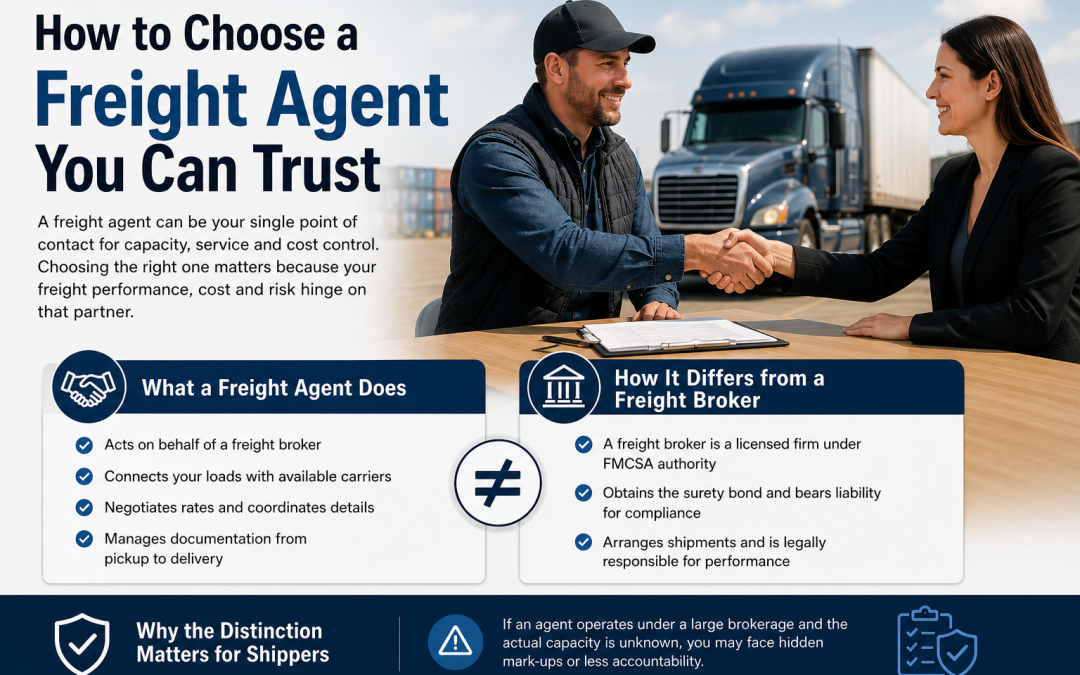
A freight agent can be your single point of contact for capacity, service and cost control. Choosing the right one matters because your freight performance, cost and risk hinge on that partner.
What a Freight Agent Does — and How It Differs from a Freight Broker
A freight agent acts on behalf of a freight broker to connect your loads with available carriers. They negotiate, coordinate and treat documentation from pickup to delivery. truckstop.com+1
By contrast a freight broker is a licensed firm under Federal Motor Carrier Safety Administration (FMCSA) authority that arranges shipments, obtains the surety bond and bears liability for compliance. Wikipedia+1
For shippers the distinction matters. If an agent operates under a large brokerage and the actual capacity is unknown, you may face hidden mark-ups or less accountability.
How to Choose a Freight Agent or Broker You Can Trust
Carrier sourcing & asset-fleet vetting
Look for a partner that can source carriers across modes: FTL, LTL, reefer, flatbed. Ensure each carrier has been vetted for safety, insurance, asset condition and performance. At One Freight Broker we only use asset-based fleets or trusted dedicated providers so you have direct accountability.
Transparent pricing model: low fixed margin, full carrier name & rate disclosure
Many brokers hide the carrier name or layer mark-ups. We use a low fixed margin so you know our incentive is aligned with yours. We disclose carrier names and actual paid rates so you see the full picture.
Rate stability and contracting vs spot market
If your lanes run regularly, a route guide contract with stable pricing delivers better outcomes than pure spot. With One Freight Broker we build the contract vs spot mix that fits your demand-pattern and avoid wild swings.
Accessorials, on-time delivery and service performance metrics
Accessorials such as detention, live-load or unloading delays often blow up cost. Ask for transparency on how they are handled. We score performance including on-time delivery, detention hours and service metrics.
Drop trailer programs, live-load options, dedicated lanes, route guide design
Depending on your lane mix you may benefit from drop trailer programs (pre-positioned trailers ready to load) or live-load services. Dedicated lanes or a formal route guide give predictability. We help design all of these based on your freight profile.
Common Questions Shippers Ask (and the Answers They Need)
How to find a transparent freight broker or freight agent
Ask these questions: “Will I see the carrier name and actual rate?”, “Is your margin fixed or variable?”, “What happens if the spot-market spikes on my lane?” A transparent broker should answer clearly.
What is low fixed margin pricing in brokerage?
It means the broker applies a set margin on top of the carrier cost—not adjusting it up when market conditions allow. This removes the incentive to “play the spread”.
Can I see the carrier name and rate?
Yes. That disclosure means you know exactly who is hauling your freight and how much they are being paid. It builds trust and accountability.
Contract vs spot: building a stable route guide
Contracting lanes gives predictable pricing and better service but requires lane profile data and volume certainty. Spot is useful for ad-hoc loads but carries cost volatility. A blend of both is optimal.
What is a drop trailer program and when does it make sense?
A drop trailer program places empty trailers at your facility so you load when ready. This improves flexibility, reduces detention and improves on-time delivery in high-volume or variable-load facilities.
How does carrier sourcing and vetting work?
It involves reviewing fleet size, asset age, safety ratings, insurance certificates (COI), ELD compliance, past claims, driver turnover and performance scorecards.
How to avoid back-solicitation issues in freight brokerage?
Back-solicitation happens when a carrier you did not approve gets the load or when the broker re-books the load with a lower rate unknown to you. Insist on full disclosure and a clause prohibiting that practice.
Real-World Lane Scenario: Applying These Criteria in Practice
Example #1: Dry van lane – Midwest to Southeast (seasonal peak)
A shipper moving dry van loads from Chicago to Atlanta saw spot rates spike by 45 % during a seasonal peak. With a contracted route guide under a transparent broker they secured capacity at a consistent rate, avoided surge, and maintained on-time delivery at 97 %.
Example #2: Flatbed specialized freight (machinery, oversize)
A manufacturer needed flatbed loads for oversize machinery across multiple states. They selected a broker that disclosed the carrier details and used vetted asset-based fleets. The outcome: fewer claims, securement issues and a 25 % reduction in freight cost over 12 months.
At One Freight Broker we replicate that model: we pair your lanes to the right mode, source and disclose the carrier, lock in the margin, and monitor performance through our scorecards.
Why One Freight Broker Offers a Better Agent/Broker Model
Our business model: low fixed margin, carrier name & rate transparency
We apply a margin that is fixed, not variable. You see the carrier name and the rate they are paid. That means zero hidden mark-ups, zero surprise re-books.
Vetted asset fleets + no back-solicitation clause
Every carrier in our network is asset-based, meets strict safety and compliance criteria, and is reviewed quarterly. We do not allow back-solicitation. Your freight stays with approved carriers.
Service guarantee, real-time visibility, and long-term procurement partnership
We provide real-time tracking, performance dashboards and quarterly business reviews. We treat your freight procurement as a long-term relationship, not a transactional spot load.
How to get started
Visit our [Request a Quote] page. Share your lane profiles. We will analyse your volume, mode mix, and performance goals. Then we’ll build a transparent plan together.
Practical Takeaway for Shippers
Checklist for evaluating your current freight agent/broker
- Do you see the carrier name and actual rate?
- Is margin fixed or arbitrarily added?
- Are your lanes contracted or purely spot?
- Do you have accessorial transparency and performance data?
- Does the broker use vetted asset-based fleets and protect you from back-solicitation?
Next steps: audit your lanes, compare transparency, lock in contracts
Review your top 10 lanes, check if you have stable pricing and transparency. If not, request quotes under a transparent model.
Partner with One Freight Broker
At One Freight Broker, we are committed to helping you navigate the complexities of PTL and LTL national shipping. Whether you’re a small or medium-sized business, our tailored solutions are designed to meet your specific shipping needs efficiently and cost-effectively.
Our approach enables shipping partners of all sizes to establish direct, beneficial, and enduring connections with carriers. We assist businesses in managing shipments every month, facilitating cost and time savings by linking them with dependable trucking allies. Our service offers an unprecedented depth of strategic insight and procurement expertise. Since our founding in 2013, we’ve significantly reduced shipping costs for our clients, amounting to tens of millions in savings, and have enhanced the profitability of asset fleets by reducing their dependence on intermediaries.
Contact Us Today
Ready to simplify your shipping experience? Go to our [Request a Quote] page and submit your lane list. We will respond with carrier name, paid rate, our fixed margin and performance metrics. To request a transparent quote or learn more, visit 1fr8.broker.