
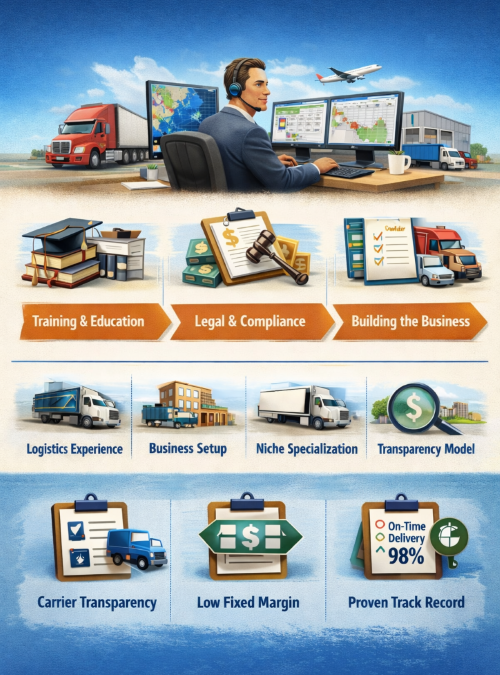
Understanding how long it takes to become a freight broker matters to shippers who want to assess the maturity and reliability of the partner they choose. This guide outlines the timeline, key steps, and what logistics managers should look for in a transparent freight brokerage.
What is a Freight Broker and Why Timeline Matters
A freight broker serves as the intermediary that connects shippers with trucking carriers. They do not own the trucks but arrange capacity, negotiate rates, handle documentation and ensure the freight moves as promised. Many shippers focus on outcomes such as on-time delivery, rate stability and accessorial transparency. That means if a broker is newly set up or still building its network, there can be risk.
Typical Timeline Breakdown
Training and Industry Knowledge (Weeks to Months)
Before applying for authority many prospective brokers invest in training or work within a logistics firm to gain experience. Some online courses take 2-3 weeks while more robust programs or mentorships stretch to 3-4 months.
Legal & Compliance Steps (4-6 Weeks)
Once ready the licensing steps begin: forming your business entity, applying via the Federal Motor Carrier Safety Administration (FMCSA) Unified Registration System (URS), filing for a $75,000 surety bond (BMC-84) or trust, and identifying a process agent (BOC-3). The application process alone typically takes 4-6 weeks.
Operational Readiness: Systems, Vetting Carriers, Lanes (3-6+ Months)
After licensing, meaningful value for a shipper comes when the broker has:
- Vetted asset-based carriers with strong safety records
- Systems in place: TMS, load board access, carrier compliance checks
- Lane profiles and service guarantees (FTL, LTL, reefer, flatbed, dedicated)
- Established key programs like drop trailer or live load where applicable
- Building this operational readiness often takes 3-6 months or longer depending on scale.
Factors That Accelerate or Slow the Process
The time it takes to become a freight broker can vary widely because every startup faces a different mix of experience, resources, and goals. Some brokers move from licensing to operations in a matter of weeks, while others take several months to build systems, recruit carriers, and establish shipper relationships. Factors such as prior logistics experience, business setup complexity, niche specialization, and transparency practices all influence how quickly a brokerage can become operational and trusted.
Existing Logistics Experience vs Starting Fresh
Individuals with prior experience in logistics, trucking, or transportation management often progress faster. They already understand rate negotiation, carrier vetting, and regulatory compliance, so they can focus on operations immediately. Someone starting from scratch usually spends extra time learning industry terms, technology, and compliance requirements before applying for authority or approaching clients.
Business Setup Complexity
The structure and scale of the new business directly affect the launch timeline. Setting up a limited liability company, securing a BMC-84 surety bond, and arranging insurance are standard, but adding advanced systems like a transportation management platform or factoring agreements can extend setup time. Those who build a more complete foundation from day one may take longer initially but often gain efficiency later.
Niche Focus: FTL, LTL, Reefer, Flatbed, Dedicated Lanes
A broker that focuses on a specific niche—such as refrigerated (reefer), flatbed, or dedicated lanes—usually spends more time sourcing specialized carriers and ensuring compliance with additional regulations or equipment standards. Full truckload (FTL) and less-than-truckload (LTL) brokers may scale faster, but specialized niches require more testing, certifications, and relationship building before consistent operations can begin.
Transparency Model vs Traditional Spread-Model
Adopting a transparent model that discloses carrier names, rates, and a fixed margin often requires more detailed setup. Systems must track cost breakdowns accurately and provide reporting for clients. While this increases the initial workload, it creates long-term trust and rate stability, allowing shippers and brokers to collaborate efficiently once operations are established.
What Shippers Should Ask When Vetting a Freight Broker
Vetting a freight broker is one of the most important steps a shipper can take before moving high-value or time-sensitive freight. A broker acts as the extension of your logistics team, so their practices directly impact service quality, cost stability, and compliance. Choosing the wrong partner can lead to hidden markups, poor carrier performance, and even legal exposure if a carrier lacks proper authority or insurance. Asking the right questions helps shippers identify transparent partners who prioritize accountability and long-term efficiency.
Transparent Freight Brokerage: Carrier-Name Disclosure & Rates
A transparent freight broker should always be willing to share which carrier is hauling your freight and what rate that carrier is paid. Seeing both the carrier name and line-haul rate eliminates blind spots and builds trust between shipper and broker. It also allows shippers to verify safety scores, authority status, and performance metrics. When transparency is standard practice, pricing discussions shift from suspicion to strategy, enabling collaborative planning for lanes, service levels, and contingency options.
Low Fixed Margin Model and Rate Stability
A broker who works on a low fixed margin rather than an arbitrary percentage mark-up aligns their success with the shipper’s. The fixed margin removes the incentive to “play the spread” between carrier buy and shipper sell rates. This approach produces rate stability over time and simplifies auditing. Shippers can budget accurately, even when market conditions fluctuate, because their partner is not profiting from volatility but focusing on service reliability and cost efficiency instead.
Carrier Sourcing Program, Drop Trailer, Live Load, Route Guide
Brokers that invest in structured carrier sourcing programs deliver consistent performance. They onboard and score asset-based carriers for safety, on-time delivery, and capacity fit. Operational programs like drop trailer and live load solutions reduce detention and improve yard efficiency, while a documented route guide ensures the right carrier is matched to the right lane. These practices demonstrate a broker’s operational maturity and commitment to reducing disruptions before they occur.
Contract vs Spot Freight: Building a Stable Route Guide
A broker’s balance between contract and spot freight defines their ability to provide dependable service. Relying solely on the spot market exposes shippers to sudden rate swings and limited capacity during peak seasons. In contrast, contract lanes and structured route guides lock in predictable pricing and carrier commitment. A broker that proactively manages both markets can advise when to secure contracts and when to use spot coverage strategically—helping shippers maintain service continuity and protect their transportation budgets.
Why Partnering with One Freight Broker Makes a Difference
At One Freight Broker we bring a transparency-first model: we disclose carrier names and rates, apply a low fixed margin, use only vetted asset fleets, and we do not lock shippers into back solicitation traps. Because our systems, carrier sourcing and service programs are already operational, a shipper can reach stable performance faster than with a newly formed brokerage. For example, we launched a reefer lane covering Florida to the Northeast and achieved 98% on-time deliveries within the first 90 days through our drop-trailer and live load program. (Real-world lane example)
By contrast a broker still building its network may take 6-9 months to fully stabilise.
Key Takeaways for Logistics Managers
- From start to license typically takes 4-6 weeks; reaching operational maturity often takes 3-6 months or more.
- Ask the right transparency questions: carrier name, rate disclosure, low margin models, service programmes.
- A broker aligned with your goals helps drive on-time performance, cost stability and accessorial visibility.
- Partnering with a proven transparent broker accelerates value and reduces risk of start-up-phase failures.
Contact Us Today
Ready to simplify your shipping experience? Contact One Freight Broker to discover how our expertise can benefit your business, ensuring your cargo is in safe hands every step of the way.
For more information on how we can assist your business, visit our website at 1fr8.broker.