
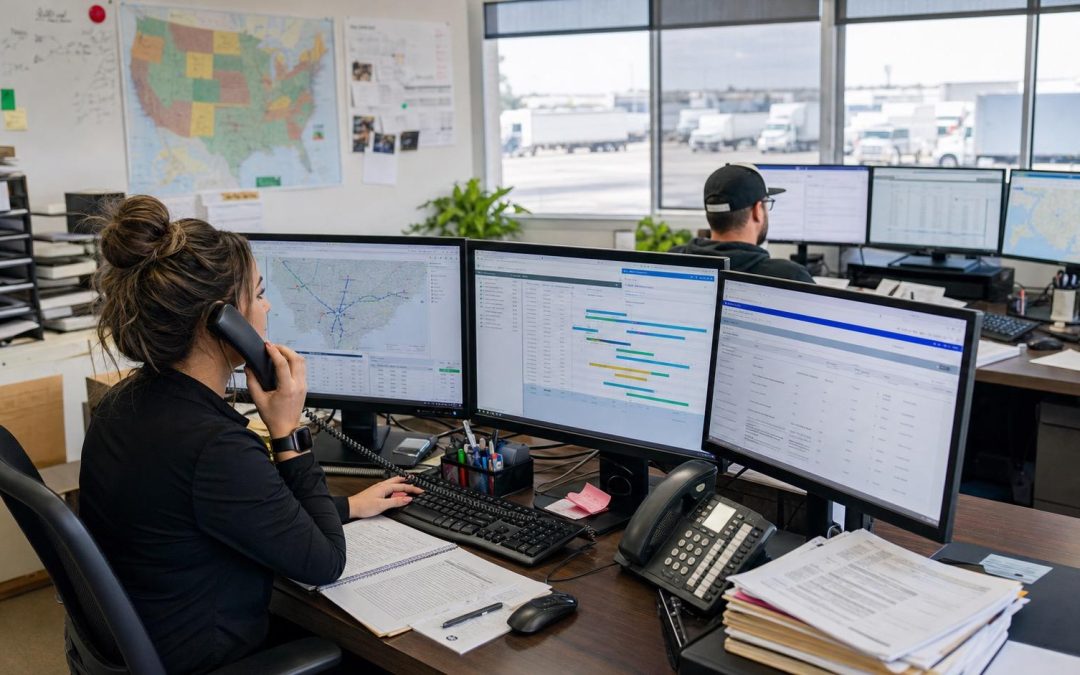
Truck dispatcher license questions come up often in Texas. Shippers hear “dispatcher,” “broker” and “agent” and it can be hard to tell who is actually responsible for their freight. This matters because the party that holds authority, insurance and financial responsibility is not always the one on the phone with your driver.
This guide walks through truck dispatcher license requirements in Texas, how they differ from a licensed freight broker, and what logistics leaders should check before awarding freight.
What a Truck Dispatcher Actually Does for Carriers in Texas
At a basic level, a truck dispatcher works on behalf of the carrier. They help keep trucks loaded, manage day to day communication with drivers, and coordinate with brokers or shippers. Many dispatchers specialize by trailer type such as dry van, reefer or flatbed.
On a Dallas to Houston dry van lane, for example, a dispatcher might watch load boards, negotiate with freight brokers, confirm pickup times and then guide the driver through the day. On a San Antonio to Laredo reefer lane, they may need to coordinate temperature set points, strict delivery windows and border timing.
From a shipper’s point of view, the dispatcher is often the voice on the phone. The risk, however, usually sits with the carrier that employs the dispatcher and with any freight broker that sits between you and that carrier.
Do You Need a License to Be a Truck Dispatcher in Texas?
No nationwide “dispatcher license”
There is no single nationwide “truck dispatcher license” in U.S. law. Industry guides consistently explain that dispatchers are generally not required by statute to hold a specific dispatcher license, although many employers and training providers talk about “certifications” and “courses.” DAT+1
That can be confusing because many pages use licensing language loosely. In practice, law and regulators focus on the role someone plays in the transaction, not the job title on a business card.
When dispatcher work becomes brokerage
If a dispatcher simply supports a carrier, uses the carrier’s authority and the shipper contracts with either the carrier or a licensed broker, that dispatcher does not normally need separate authority.
The picture changes when a dispatcher starts to:
- Take freight directly from shippers
- Decide which carrier hauls the load
- Invoice the shipper and pay the carrier from that payment
At that point the dispatcher is acting like a property broker. Federal rules require anyone brokering freight for hire to hold FMCSA broker authority, file a BMC 84 surety bond or BMC 85 trust, and complete broker registration. FMCSA+2bryantsuretybonds.com+2
In short, if a dispatcher is “in the middle” of the money flow between shipper and carrier, they are probably a broker in the eyes of FMCSA. That is true in Texas and in every other state.
What is specific to Texas
Texas does not issue a special “Texas dispatcher license.” Instead, compliance in Texas focuses on carriers and business entities.
- Carriers that operate only within Texas borders need a TxDMV number, also called a certificate of operating authority, plus required insurance. TxDMV
- Interstate carriers need a USDOT number, an MC number where applicable, and Unified Carrier Registration. FMCA Filings
- Any separate dispatch or brokerage business that is transacting business in Texas may need to register its entity with the Texas Secretary of State and register for tax with the Texas Comptroller. Texas Secretary of State+1
For shippers, the takeaway is simple. Ask who holds what:
- Which party has the FMCSA authority and broker bond
- Which party has the motor carrier authority
- Which entity is legally doing business in Texas
“In Texas, your risk is tied to who holds FMCSA authority, not the job title on a business card.”
Texas Requirements for Carriers, Dispatchers and Brokers
Intrastate vs interstate freight
A Houston to Austin dry van lane that never leaves Texas follows intrastate rules. The carrier must hold a TxDMV number and maintain state required insurance. TxDMV
A Houston to Oklahoma City load, by contrast, is interstate freight. That brings in USDOT and MC numbers plus federal insurance and safety rules. For reefer lanes into border markets, you may also layer on FSMA food safety programs and more complex handoffs.
Dispatchers need to understand which set of rules applies to each move, even when they do not personally hold any license.
Business registration and compliance
Independent dispatch and brokerage outfits that operate in Texas should:
- Register the business entity with the Texas Secretary of State
- Register with the Texas Comptroller for tax purposes
- Maintain proper COI and records on any carriers they help source
Shippers should treat unregistered entities and informal dispatch services with caution. If something goes wrong on a Dallas to El Paso flatbed load, you want clear visibility into which legal entity actually touched the transaction.
Truck Dispatcher vs Freight Broker in Texas: Who Is Responsible for Your Freight?
From a shipper’s seat, dispatcher and broker roles can blur. It helps to break responsibility into three areas: contracts, money and risk.
Who holds the contract and financial responsibility
In a standard setup:
- You contract with a freight broker or directly with a carrier.
- The broker contracts with the carrier and pays them.
- A dispatcher may work inside the carrier’s shop or as an outsourced service to help that carrier keep trucks moving.
The broker is the one with FMCSA authority and a BMC 84 bond. FMCSA+1 That bond exists to protect carriers and shippers if the broker fails to pay or otherwise fails to meet obligations.
A dispatcher who does not hold broker authority typically has no such bond. If a dispatcher sits between you and the carrier as the payor, you should treat them as a broker and verify their authority accordingly.
“A dispatcher can help a driver, but a licensed freight broker is the one backed by a bond and federal authority.”
Transparency around carrier sourcing and back solicitation
Most shippers buying FTL, LTL, reefer or flatbed capacity in Texas rely on brokers to source carriers and manage day to day execution. Problems arise when those brokers hide carrier identities, block direct communication or wrap contracts in aggressive back solicitation language.
Healthy, transparent setups tend to look like this:
- You see the carrier name and MC number on every rate confirmation.
- You understand whether capacity is asset based or coming from small fleets and owner operators.
- Back solicitation language protects the broker from being cut out of active opportunities but does not stop you from knowing who hauled your freight.
“You should not have to guess which carrier is hauling your freight. Ask to see the carrier name, MC number and agreed rate on every Texas load.”
Impact on on time delivery, rate stability and claims
For a Dallas to Laredo reefer lane with strict delivery windows, you care about:
- On time pickup and delivery performance
- Claim ratios and how temperature claims are handled
- Detention trends and root cause
- How often your loads fall to spot vs stay on contract carriers
Good dispatchers improve execution at the truck level. Good brokers bring structured carrier vetting, ongoing scorecards and clear rules for detention and other accessorials. When both work together inside a transparent model, you get fewer surprises and more stable route guides.
How a Transparent Freight Broker Handles Texas Freight and Dispatch Relationships
One Freight Broker positions as a transparent freight brokerage with a low fixed margin. That shapes how dispatchers, carriers and shippers all interact.
Low fixed margin pricing vs spread based brokerage
Traditional brokers make more when they can buy low from a carrier and sell high to a shipper. That spread based model can reward opacity and short term thinking.
In a fixed margin approach, the broker publishes or clearly discloses their margin. Once the carrier is selected, any savings from better routing, drop trailer programs or seasonal procurement tends to show up in your rate, not as extra spread.
“Low fixed margin removes the incentive to play the spread.”
In practice, that can stabilize Texas route guides on key lanes such as:
- Houston – Dallas distribution loops
- DFW – San Antonio consumer goods
- Austin – border markets during seasonal reefer peaks
Carrier name and rate disclosure
One Freight Broker’s model emphasizes carrier name and rate disclosure so shippers can see the full picture on each move. That includes:
- Carrier legal name and MC / DOT identifiers
- All in rate agreed with the carrier
- The broker’s margin where commercial terms allow
“We disclose carrier names and rates so shippers see the full picture.”
For procurement teams running RFPs, that makes it easier to explain awards, review performance and adjust route guides without losing cost transparency.
You can also Request a Quote if you want to see how this looks on your own Texas lanes.
Vetted asset fleets, no back solicitation trap and accessorial transparency
A transparent model relies on vetted asset fleets and clear rules.
Key elements:
- Safety: FMCSA safety rating reviews and ongoing monitoring
- Insurance: COI verification for liability and cargo, with documented limits
- Operations: ELD compliance, hours of service discipline and securement for flatbed
- Food safety: FSMA aligned processes for Texas reefer freight where required
On the contract side, you should see:
- Reasonable back solicitation language that protects relationships without trapping shippers
- Clear detention, layover, TONU and lumper policies
- Accessorial reporting so you can see which facilities in Texas consistently generate extra cost
When dispatchers, carriers and brokers all operate against that shared framework, on time performance and cost control both tend to improve.
FAQs about Truck Dispatcher License Requirements in Texas
Do truck dispatchers need a license in Texas?
There is no special Texas dispatcher license. Dispatchers who simply support carriers under that carrier’s authority usually do not need separate authority. If a dispatcher brokers freight for hire, they need FMCSA broker authority and a bond, just like any other freight broker. Wise Systems+1
Who is legally responsible, the dispatcher or the freight broker?
Legal responsibility follows authority and contracts. The motor carrier is responsible for the truck and driver. The freight broker holds responsibility under its FMCSA authority and broker bond where it arranges freight. A dispatcher without authority is usually not the responsible party to the shipper.
Can a dispatcher operate as a broker without a freight broker license?
They can, but it is not legal. If a dispatcher is taking loads directly from shippers and paying carriers, they are acting as a broker and must hold broker authority and a bond. Operating without that authority creates regulatory and financial risk for everyone involved.
How can I verify a freight broker’s authority and bond?
Use FMCSA’s public registration tools to check the broker’s MC number, status and proof of BMC 84 or BMC 85 filing. Reputable brokers will provide this information as part of onboarding. FMCSA+1
How should shippers in Texas vet dispatchers, carriers and brokers?
Start with authority checks, insurance verification and business registration. Then review safety ratings, COI, claim history and accessorial trends on core lanes. Finally, run a pilot period on Texas freight to see how the broker and dispatchers actually perform.
To request a transparent quote or learn more, visit 1fr8.broker.