
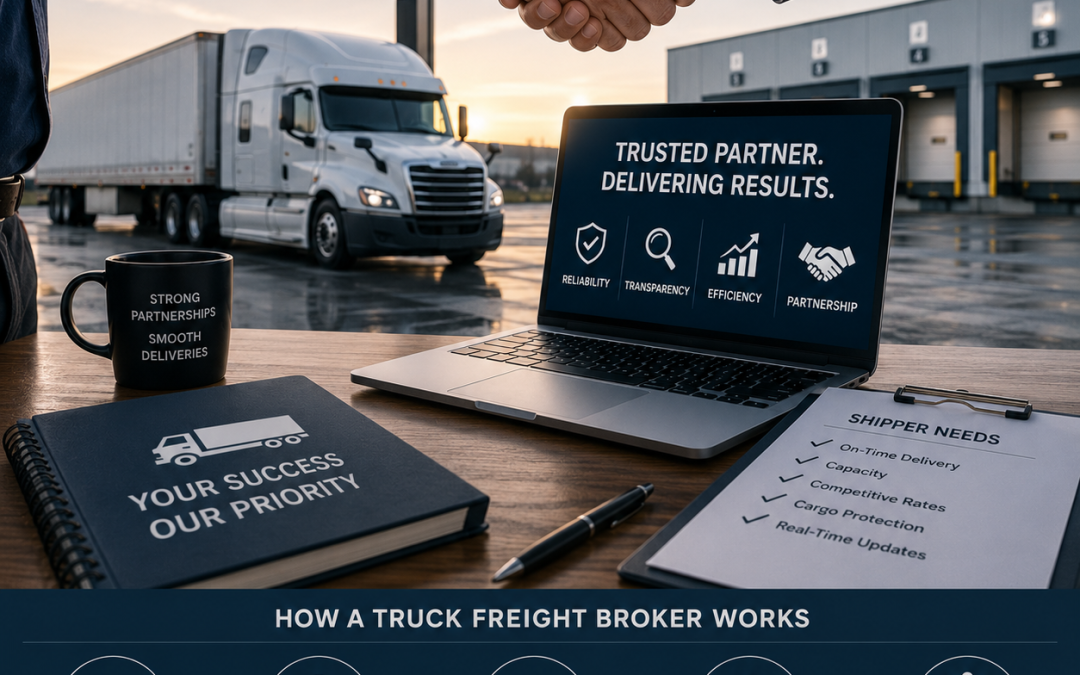
Choosing the right truck freight broker matters more than ever. With supply-chain pressures, capacity shifts and cost transparency under scrutiny, logistics teams must pick a brokerage partner that delivers reliability and clarity.
What a Truck Freight Broker Does for Shippers
Connecting Shippers and Carriers
A broker connects a shipper who needs to move freight with a carrier that has the correct equipment and capacity. They match shippers and carriers, but they often do more than find a truck. Sheer Logistics+1
For example, a food and beverage manufacturer needs a refrigerated trailer from Chicago to Atlanta. The broker secures a vetted carrier with a valid DOT authority and confirms temperature-control capability.
Negotiating Rates, Managing Compliance & Documentation
Once the carrier is identified, the broker negotiates the rate and handles pickup scheduling, bill of lading, proof of delivery and other back-office tasks. DAT
A shipper sending a full truckload (FTL) of electronics from Los Angeles to Dallas benefits from the broker checking the carrier’s insurance certificate and CSA safety score before dispatch.
Handling Specialized Modes (FTL, LTL, Reefer, Flatbed)
Good brokers provide capacity across modes. Whether it is FTL dry van, LTL consolidation, a seasonal reefer lane or an oversized flatbed, they coordinate what the shipper needs. USA Truckload Shipping
For instance a construction component manufacturer requires a flatbed for an oversized module from Houston to Phoenix. The chosen broker arranges the flatbed asset, securement gear and route permit.
Why Many Brokers Fall Short on Transparency and Service
Hidden Margins and No Carrier Name Disclosure
Many brokers bill the shipper one rate, pay the carrier another and keep the spread undisclosed. That gives little insight into the value being delivered. FreightWaves Ratings
Shippers deserve to know: which carrier is actually hauling the load and how much they are being paid.
Rate Instability from Spot-Market Fluctuations
Moving purely on the spot market can mean volatile rates, indifferent service and capacity surprises. A shipper may receive a quote, but on the day a weaker carrier is used or the rate is higher.
This undermines planning. A stable program avoids chasing day-to-day pricing swings.
Accessorial Surprises and Poor On-Time Performance
Accessorial fees like detention, layover or live-load often creep in when contracts are vague. If the broker does not publish actual on-time delivery metrics or carrier scorecards, service suffers.
Shippers face the fallout: delayed product, stock-out risk or higher freight spend.
What to Look for in a Transparent, Sustainable Brokerage Partner
Low Fixed Margin Model & Carrier Name Disclosure
Choose a broker that uses a low fixed margin or set fee rather than hidden spread. This aligns the carrier-broker-shipper triangle around service not margin play.
And insist on full carrier disclosure. If you know the carrier name, you can track safety, equipment age and performance.
Vetted Asset Fleets, No Back-Solicitation Trap
Transparent brokerages often use asset-based carriers or have rigorous partner fleets. They forbid “back-solicitation” — carriers taking your business directly — which protects your lane stability and volume.
Ensure the broker shows you their vetting process: COI, DOT authority, ELD compliance, CSA scores.
Carrier Scorecards, On-Time Delivery Metrics, Safety & COI Checks
Evaluate prospective brokers on published metrics: on-time percentage, claims ratio, dead-head percentage, detention hours.
Ask for proof: “What is your average OTP on dedicated lanes in the past 12 months?” or “What is your cargo damage rate?” This quantifies reliability.
Route Guide, Contract vs Spot Strategy, Drop Trailer & Dedicated Lane Options
Look for a broker that helps build your route guide — a set of lanes with defined service expectations and volumes. Contracting those lanes gives you rate stability and capacity priority versus ad-hoc spot buying.
A drop-trailer program – where a trailer is dropped at origin and picked up at destination – reduces pickup delays and improves on-time delivery.
Also ensure the broker supports transitions across modes: dry van, reefer, flatbed, LTL.
How 1fr8.broker Delivers Real Value to Shippers
Example: A Dry Van FTL Lane with Stable Rate
A national retailer shipping from Memphis to Boston selected 1fr8.broker. The broker provided full carrier name disclosure, a low fixed margin, and a multi-year contract. The on-time delivery improved from 89 % to 96 % and freight spend dropped 7 %.
Because the broker sourced a vetted asset fleet and locked in a dedicated lane, rate swings from the spot market were avoided.
Example: Seasonal Reefer Capacity for Food & Beverage
A food manufacturer faced seasonal peak from Florida to New York. 1fr8.broker offered early booking, carrier name transparency and agreed accessorial terms (no surprise detention fees). The result: product shipped 30 % sooner than previous year and spoilage declined.
Example: Flatbed Oversized Load Securement and Asset Fleet Vetting
A manufacturer needing a flatbed for oversized steel beams from Detroit to Denver used 1fr8.broker. The broker disclosed the carrier, verified the equipment, securement methods and required permits. Shipment arrived on time, safely and at a predictable rate.
Practical Steps for Shippers to Vet Their Freight Broker
Choosing a truck freight broker is not just about securing the lowest rate. It’s about verifying that your partner operates with transparency, consistency, and measurable accountability. Many shippers overlook the due diligence process when selecting a brokerage, which can lead to hidden costs, poor service, or unreliable capacity. These four steps help procurement teams evaluate a broker’s performance and ensure that your freight partner aligns with your long-term logistics goals.
Ask for the Carrier Name and Rate Breakdown
A transparent broker should always disclose the carrier name and rate breakdown. This step confirms that the carrier is legitimate, insured, and compliant with DOT and FMCSA standards. When you can see what the carrier earns and how much the broker keeps, you understand the true cost structure and remove guesswork from the partnership. Shippers should make this disclosure a non-negotiable requirement before awarding any lanes.
Review On-Time Performance and Accessorial Transparency
On-time delivery performance is one of the clearest indicators of service quality. Request a broker’s on-time percentage, detention averages, and claims ratio before engaging. Ask how they track these KPIs and whether they publish carrier scorecards. Accessorial transparency is equally critical—detention, layover, or truck order not used (TONU) fees should be clearly defined in writing. Brokers who share these metrics openly demonstrate that they manage service, not just rates.
Test With a Pilot Lane and Monitor Scorecards
Before onboarding a broker across your full network, run a pilot on one or two strategic lanes. Use this test to evaluate communication, pricing consistency, and actual on-time results. Request performance scorecards during the pilot to see how the broker manages exceptions, detention, and carrier accountability. This data-driven approach gives you a clear picture of how the brokerage performs under real-world conditions before scaling the relationship.
Incorporate into Your RFP / Procurement Process
When you issue an RFP, include transparency, margin structure, and carrier disclosure as evaluation criteria. Require bidders to outline how they vet carriers, manage back-solicitation risks, and measure on-time performance. By integrating these questions into your procurement process, you elevate the quality of your freight partnerships. Shippers who reward transparency and reliability build stronger route guides, achieve more stable rates, and reduce the hidden friction that drives up total logistics costs.
Embed these criteria in your procurement evaluation to ensure your broker is aligned with your supply-chain goals.
Partner with One Freight Broker
Selecting a truck freight broker is not just about price. It is about transparency, service, and long-term alignment. By focusing on carrier name disclosure, low fixed margin, vetted asset fleets and measurable KPIs you build a partnership you can trust. Begin with a pilot lane, hold the broker accountable with scorecards, and incorporate these criteria into your procurement process.
Here at One Freight Broker, our approach enables shipping partners of all sizes to establish direct, beneficial, and enduring connections with carriers. We assist businesses in managing shipments every month, facilitating cost and time savings by linking them with dependable trucking allies. Our service offers an unprecedented depth of strategic insight and procurement expertise. Since our founding in 2013, we’ve significantly reduced shipping costs for our clients, amounting to tens of millions in savings, and have enhanced the profitability of asset fleets by reducing their dependence on intermediaries.
Our extensive service range, competitive pricing, and advanced technological solutions make One Freight Broker the go-to choice for shippers seeking reliable freight transportation services.
Contact Us Today
Ready to simplify your shipping experience? Contact One Freight Broker to discover how our expertise can benefit your business, ensuring your cargo is in safe hands every step of the way.
For more information on how we can assist your business, visit our website at 1fr8.broker.