
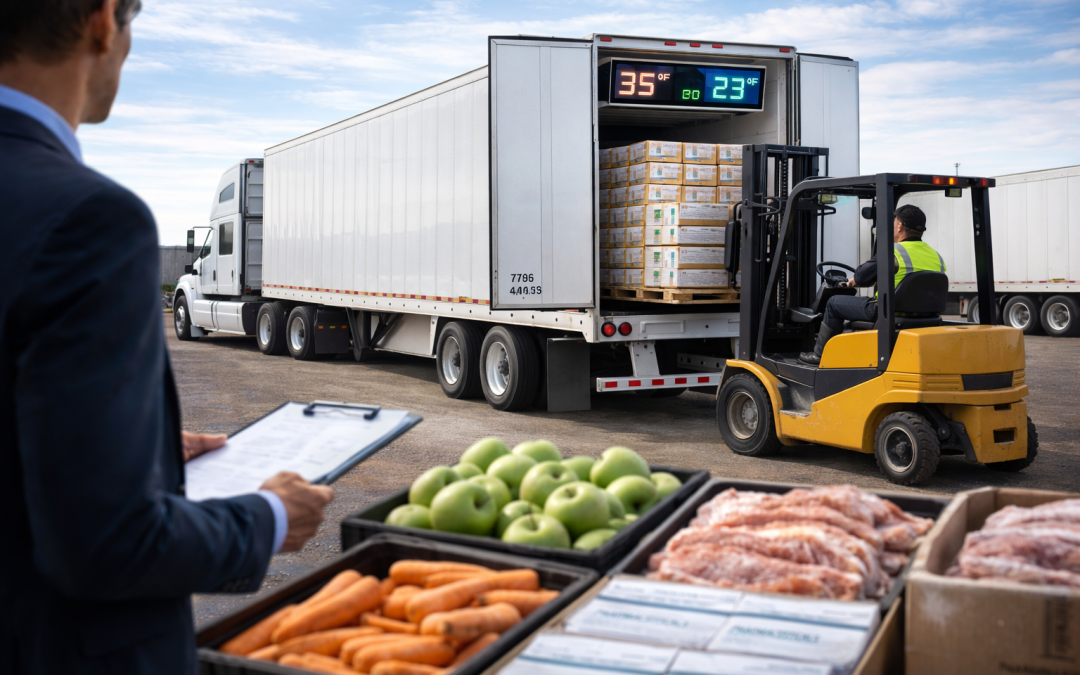
Cold freight services are critical for shippers moving temperature-sensitive goods such as perishables, pharmaceuticals and frozen inventory. Choosing the right freight broker can make or break your supply chain performance. This article walks through what to look for, the questions to ask and how transparency changes the game.
What “cold freight services” really mean for shippers
Defining temperature-controlled, refrigerated, frozen and chilled loads
Cold freight refers to any freight movement requiring temperature control such as chilled or frozen shipments. That includes food, beverages, pharmaceuticals and seasonal inventory. It involves including FTL, LTL and dedicated lanes with reefer trailers. Industry observers say this sector is growing fast as demand rises for freshness and global distribution. Research and Markets+2AIT+2
Key challenges shippers face in cold chain freight
Shippers contend with equipment breakdowns, temperature excursions, lack of visibility, detention charges, surge pricing and carrier capacity constraints. For example, one shipper moved overnight chilled loads but had multiple temperature violations simply because the broker did not monitor the trailer pre-departure. As one industry piece notes, “cold freight faces challenges like broken equipment, temperature shifts and human error.” Waggon
Why traditional freight brokers often fall short for cold freight
Spot pricing volatility and lack of lane stability
In cold freight, unpredictable demand (seasonality for produce, pharma temperature spikes) makes spot pricing volatile. Traditional brokers react to market swings rather than planning dedicated lanes. That means cost instability and service risk.
Opaque carrier sourcing, margin mark-ups and hidden accessorials
Many brokers do not disclose the carrier name or the freight rate. The broker margin becomes a hidden spread. Shippers may not know they are paying a large markup. Accessorials like detention, re-shipment or temperature guarding often become unexpected cost buckets.
Limited visibility into asset-based carriers, ELD, safety ratings
When the broker uses random carrier selection each time there is less oversight over safety scores, COI, asset availability or ELD compliance. For cold freight, equipment reliability is non-negotiable. For example, a large refrigerated trucking provider highlights that temperature-controlled shipping is about safeguarding product integrity. chrobinson.com
What a transparent freight brokerage brings to cold freight
Carrier name and rate disclosure: Why it matters
Transparency means the shipper knows exactly which carrier is hauling, what rate is paid, and what margin the broker earns. That aligns incentives, builds trust and enables better benchmarking. At 1fr8.broker we believe “we disclose carrier names and rates so shippers see the full picture.”
Low fixed margin vs spread-based brokerage pricing
With a fixed margin the broker’s incentive is service and performance not chasing spread. The model removes the incentive to inflate the carrier cost. Quote: “Low fixed margin removes the incentive to play the spread.”
Stable dedicated lanes, drop trailer programs and route-guide design
Stable lanes reduce risk of equipment scarcity or exorbitant accessorial charges. Drop trailer programs allow trailers to be left at origin or destination enabling quicker loading/unloading and improved on-time delivery. Example: a retailer using a drop trailer program saw OTP improve by several points year-over-year.
Selecting the right freight broker for your cold chain lanes
Questions to ask: procurement checklist
- Will I receive the carrier name and rate every load?
- What is the broker’s margin, and is it fixed or variable?
- Does the broker provide vetted asset‐based carriers with refrigerated trailers?
- What are your accessorial policies for detention, re-shipment, temperature guard?
- How do you measure and report on on-time delivery, temperature excursions, deadhead miles?
- Is there a contract vs spot model in place for stability?
What to evaluate: asset-based carriers, vetting, safety and COI
Verify DOT authority, CSA scores, ELD compliance, trailer age, refrigeration maintenance records, contingency plans. Ask for sample COIs and on-time performance data.
Example lane case: chilled produce east-west US corridor
Imagine you ship chilled produce from California’s Central Valley to New York metropolitan markets weekly. A good broker would lock in a dedicated reefer asset, disclosure of carrier, fixed margin, scheduled drop trailer at origin and destination, and weekly performance scorecard. Service cost remains predictable, OTP rises and risk of spoilage falls.
How 1fr8.broker approaches cold freight services differently
Our vetted asset fleet model
We partner only with asset-based carriers that meet strict criteria for trailer refrigeration, temperature monitoring, safety ratings and capacity stability. That means you are not competing for random capacity.
Transparent rate-and-carrier disclosure
Every load you ship through 1fr8.broker comes with full carrier name and truck details. You see the actual cost paid and our fixed margin. No hidden spread.
Fixed margin pricing, accessorial transparency and on-time delivery guarantees
Our model uses a low fixed margin on each load. Accessorials are negotiated up front and passed through with line-item clarity. We build dedicated lane programs and drop trailer schedules to improve on-time delivery and reduce detention. We track performance with a lane scorecard you access monthly.
Best practices for shippers in cold freight management
Cold freight management demands precision, consistency, and transparency from both shippers and brokers. Temperature control alone does not guarantee shipment integrity—performance data, proactive risk mitigation, and smart contracting make the difference. Shippers that monitor performance and align with transparent freight partners gain stability, cost predictability, and better on-time delivery across their cold chain network.
Building lane scorecards and performance metrics
A lane scorecard helps shippers move from reactive problem solving to data-driven optimization. Track metrics such as on-time delivery percentage, temperature excursions per thousand loads, accessorial cost per shipment, deadhead miles, and claims ratio. When carriers and brokers see these KPIs monthly, accountability improves. Shippers can compare carrier performance by lane, season, and commodity to identify who consistently delivers quality service and which lanes need new capacity or rate negotiation.
Mitigating risk: temperature excursions, detention, back solicitation
Risk management in cold freight starts before the truck moves. Require pre-trip refrigeration checks, validated temperature readings, and GPS monitoring for each reefer unit. Define detention terms clearly in contracts to prevent disputes. Back solicitation—when a carrier bypasses the broker to contact a shipper directly—should be prohibited through written clauses. A broker with full carrier vetting, ELD compliance verification, and accessorial transparency can protect both product integrity and shipper relationships.
Contract vs spot: creating a stable supply chain model
Balancing contract and spot freight determines how well a shipper can control cost and service reliability. Contracting recurring cold lanes with fixed pricing and dedicated assets reduces exposure to seasonal rate spikes and equipment shortages. Spot freight is useful for overflow or unexpected demand but brings volatility and less carrier accountability. Transparent brokers like 1fr8.broker use lane profiling and performance data to help shippers decide when to lock in contracts and when spot makes sense, creating a more stable and predictable cold chain network.
Partner with One Freight Broker
If you handle temperature-sensitive freight you cannot settle for a generic broker model. You need transparent relationships, direct carrier visibility, stable pricing and measurable performance. At 1fr8.broker we deliver all of the above plus a low fixed margin, asset-fleet sourcing, carrier name disclosure and dedicated/drop trailer lane design.
Our approach enables shipping partners of all sizes to establish direct, beneficial, and enduring connections with carriers. We assist businesses in managing shipments every month, facilitating cost and time savings by linking them with dependable trucking allies. One Freight Broker’s service offers an unprecedented depth of strategic insight and procurement expertise. Since our founding in 2013, we’ve significantly reduced shipping costs for our clients, amounting to tens of millions in savings, and have enhanced the profitability of asset fleets by reducing their dependence on intermediaries.
At One Freight Broker, we’re committed to providing tailored logistics solutions that align with your shipping costs and needs, whether you’re navigating domestic shipments or exploring international logistics. Our deep industry knowledge and network of reliable carriers ensure your freight is in expert hands. Let us help you streamline your logistics for maximum efficiency and cost-effectiveness.
Contact Us Today
Ready to simplify your shipping experience? Contact One Freight Broker to discover how our expertise can benefit your business, ensuring your cargo is in safe hands every step of the way. To take action, download our cold chain services checklist or Request a Quote today with 1fr8.broker.