
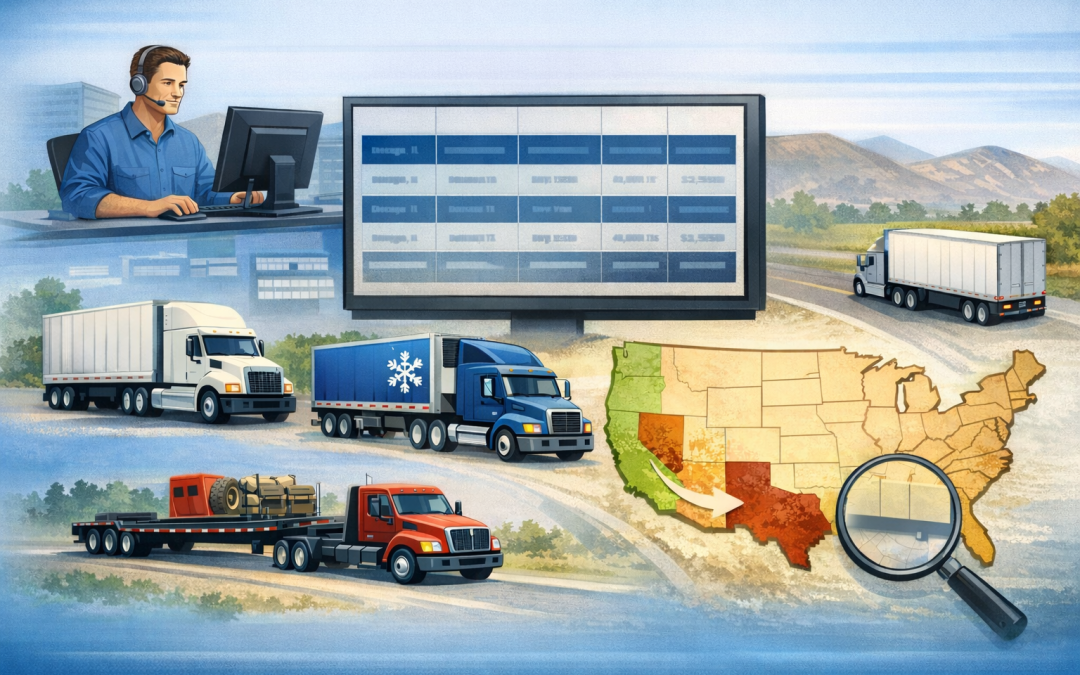
Courier load boards provide a fast way to source trucking capacity. For shippers they offer access to carriers, but they also carry risks if your brokerage partner lacks transparency. Using the right broker changes how you leverage these boards and build long-term stability.
What Are Courier Load Boards — and How Do They Work?
Courier load boards are online marketplaces where shippers, brokers and carriers connect. A shipper or freight broker lists available freight — origin, destination, equipment type, weight, delivery date. Carriers search or post available capacity and then book a load or bid on it.
There are public boards anyone can join and private boards restricted to vetted carriers. Public boards offer volume, but rate transparency and quality may vary.
Load boards support a variety of equipment types: full truckload (FTL), less-than-truckload (LTL), dry van, reefer, flatbed and hot-shot capacity. For example a dry-van carrier may scan for California to Texas loads offering minimum rate plus possible backhaul.
The Benefits and Risks of Using Load Boards for Shippers
Benefit: access to capacity and flexibility
Load boards allow shippers to tap a large network of carriers, helping fill equipment gaps quickly. They are especially useful for back-haul work or unplanned surges.
Risk: rate volatility and limited transparency
Because many carriers bid on the same load, rates may drop quickly. Furthermore, shippers may not know which carrier will show or what markup the broker applied.
Example: lane scenario
Consider a dry-van lane from Chicago to Atlanta. A shipper uses a public board to book on spot, sees rate drop 12% in one week. Contrast that with contracting a dedicated asset-based fleet through a broker who offers a fixed margin and carrier-name disclosure, locking the lane at stable cost over 12 months.
Risk: service and compliance issues
If the carrier is unvetted the shipper may face higher claims cost, delayed delivery or regulatory non-compliance. As one guide warns: “some load boards have so many participants that freight rates end up being much lower than true market rates.”
What Shippers Should Look For in a Broker Using Load Boards
Carrier sourcing and vetting
Your broker should work with asset-based carriers, verify their DOT authority, ELD compliance, insurance and safety rating. That protects you from weak links.
Transparent pricing: carrier name disclosure & low fixed margin
Ask for a model where you can see the carrier name and the rate you pay. A low fixed margin broker removes the incentive to play the spread.
Stability tools: route guide, dedicated lanes & drop-trailer programs
Instead of purely spot bookings, the broker should help you build a route guide—dedicated lanes with pre-approved fleets—and use drop-trailer programs to improve on-time delivery.
Accessorial transparency
Clarify accessorials such as detention, lay-over, securement fees (especially for flatbed/reefer). These can erode the cost advantage if hidden.
Align with your procurement process
When issuing your RFP or evaluating brokers ask: Do you disclose carrier names? What is your margin? How many lanes do you convert to dedicated? What are your on-time % and claims ratio?
How a Transparent Freight Broker Leverages Load Boards Differently
Rather than relying purely on boards, a transparent broker like 1fr8 combines board-capacity with direct contract lanes.
Contract plus spot mix
On seasonal peaks (e.g., reefer freight from Florida to Northeast in winter) the broker may use asset-based contracts for core lanes and load-board backup for surge capacity.
Drop-trailer program example
For a manufacturing client with two-day delivery requirement, the broker placed drop trailers at the shipper site. Carriers pick up without live load delay; on-time performance improved from 88% to 96%.
Why low fixed margin matters
By trimming the broker margin to a fixed low percentage you align interests: the carrier gets a fair rate and the shipper avoids hidden spreads. You reduce surprises and build trust.
Carrier name and rate disclosure
You should know which carrier moved your freight and what rate you paid. This transparency allows you to compare performance, build scorecards and hold partners to account.
Equipment-type example: flatbed
A shipper moving structural steel west-to-east contracted a dedicated flatbed lane. Because the broker pre-vetted carriers and used drop-trailer scheduling, securement issues dropped and claims were cut in half year-on-year.
Practical Action Plan for Shippers
Audit your current broker/board strategy
List all boards your broker uses, ask for rates per board, examine back-haul usage, review how many lanes are on contract vs spot.
Build your carrier scorecards & vet process
Include metrics: on-time %, claims per million ton-miles, detention minutes per load, safety rating, certification verification.
Define your route guide + dedicated lane mix
Select your top 20 lanes by volume or cost volatility. Move these into contracting with pre-approved carriers through your broker.
Request transparency metrics
Ask your broker: What is your margin? Do you disclose carrier names? What is your on-time performance? How many loads were booked via spot boards last quarter?
Internal link reference
See our [Carrier Sourcing Program] and request our transparent quote via [Request a Quote] to evaluate this model for your network.
FAQs
How to find a transparent freight broker?
Look for one who discloses carrier names, publishes margin, uses vetted fleets and shows performance metrics (OTP, claims).
What is low fixed margin pricing in brokerage?
Instead of adding a variable spread above carrier cost, the broker charges a fixed small percentage so your cost is clear and stable.
Can I see the carrier name and rate?
Yes. Ask your broker for both. Knowing the carrier allows you to hold service quality KPIs and build long-term relationships.
Contract vs spot for lane stability?
Spot bookings via load boards are flexible but rate-and-service volatile. Contracted lanes provide stability, predictable cost and better service.
What is a drop-trailer program?
Carrier drops an empty trailer at your site ahead of next pickup. You load on your schedule. It enables faster pickup, fewer live-load delays and higher OTP.
How does carrier sourcing and vetting work?
It includes verifying DOT authority, insurance (COI), safety rating, asset-based status, ELD compliance, driver turnover, equipment age and performance history.
How to avoid back-solicitation issues?
Ensure your broker has a no back-solicitation clause, you disclose carrier name, and you contract carriers directly or via approved network so they don’t go direct to your shipper.
Partner with One Freight Broker
Courier load boards offer utility and flexibility but also carry hidden risks if not managed through a transparent freight-broker model. By choosing a partner who prioritises carrier name transparency, low fixed margin, and a clear route-guide strategy, you build a more stable network with better service and cost control
When you partner with One Freight Broker, you gain access to a vast network of carriers, competitive rates, and a team of experts dedicated to optimizing your shipping process. Whether you’re shipping domestically or require assistance with more complex logistics, we’re here to ensure your freight reaches its destination efficiently and cost-effectively.
At One Freight Broker, we’re committed to providing tailored logistics solutions that align with your shipping costs and needs, whether you’re navigating domestic shipments or exploring international logistics. Our deep industry knowledge and network of reliable carriers ensure your freight is in expert hands. Let us help you streamline your logistics for maximum efficiency and cost-effectiveness.
To request a transparent quote or learn more, visit [Request a Quote] at 1fr8.broker.