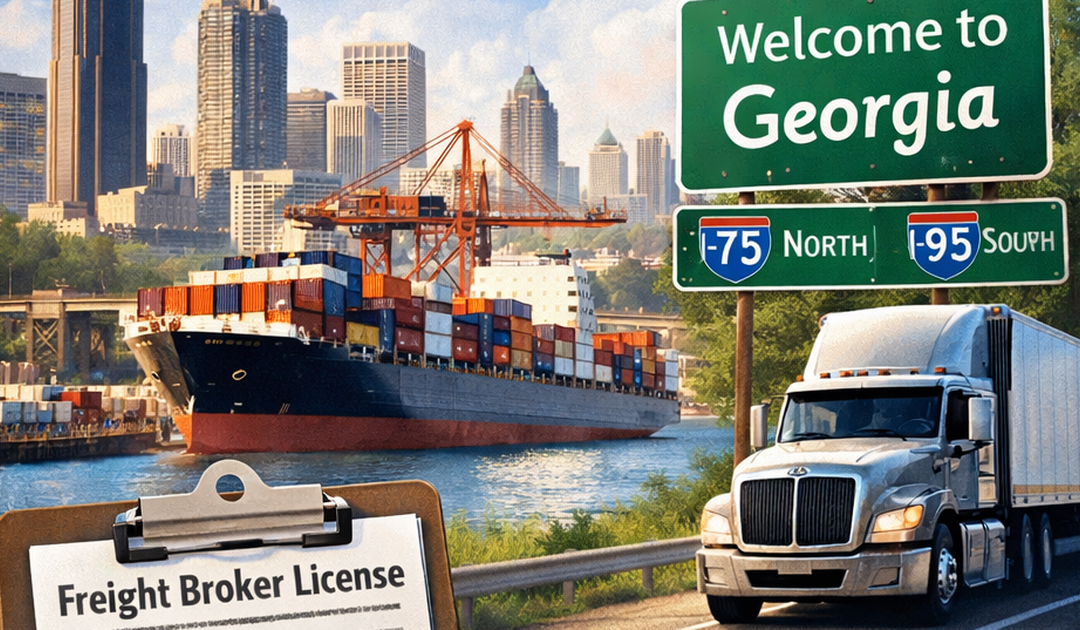
Whether you’re in Atlanta or a smaller town like Macon or Savannah, the state of Georgia is a great place to launch a freight brokerage. With a booming logistics industry, access to ports, major interstates, and a strong network of trucking professionals, Georgia offers fertile ground for anyone looking to start or grow their own freight brokerage business.
But to enter the fast-paced world of logistics and transportation, first you need to get your own freight broker license. Here, One Freight Broker will cover all the steps you need to take to achieve this. Let’s take a closer look.
What Does a Freight Broker Do?
Before we talk about the process of obtaining a license for freight brokers, we need to discuss what it is they actually do.
In the logistics industry, a broker serves as the middleman between shippers (companies that need to move goods) and carriers (trucking companies or independent drivers who have the capacity to move those goods). Aside from being matchmakers of the industry, they also handle all the logistical aspects of the shipping process.
Freight brokers are responsible for: finding loads, negotiating rates with shippers, finding available trucks, coordinating pickup and delivery, ensuring compliance with regulations, and facilitating communication between all parties. If something goes wrong during the shipping process, brokers are usually the ones to come up with alternative solutions.
By fulfilling these tasks, they enable shippers and carriers to focus on their core operations, ensuring efficiency and cost-effectiveness throughout the supply chain.
Getting Your Freight Broker License in Georgia
Georgia stands out as a top location for freight brokers due to its strategic transportation infrastructure and booming logistics industry. As home to the busiest airport in the world (Hartsfield-Jackson Atlanta International Airport) and one of the top seaports in the U.S. (the Port of Savannah), the state serves as a major hub for both domestic and international freight movement.
Additionally, Georgia also has an extensive highway system and a growing rail network, making it easier for freight brokers to coordinate shipments efficiently. This connectivity makes it ideal for new brokers looking to launch their own freight brokerage.
Now let’s talk about how to actually get your license as a freight broker in Georgia.
Step 1: Register Your Business in Georgia
The first step to becoming a freight broker in Georgia is registering your business with the Georgia Secretary of State.
Before you can do so, you need to decide on a legal structure for your business. Most brokers choose to register as a Limited Liability Company (LLC) or a corporation. You can also operate as a sole proprietor, but forming an LLC or corporation offers liability protection and may make your business look more professional to potential clients and carriers.
You will need to choose a unique business name, file the appropriate paperwork, and pay the filing fee. Georgia allows you to complete this process online through the Secretary of State’s website. Next, you have to apply for an Employer Identification Number (EIN) from the IRS. This acts as your business’s tax ID and is required for opening a business bank account and filing taxes.
Step 2: Apply for a USDOT Number and Freight Broker Authority (MC Number)
Next, let’s get into the federal requirements. All freight brokers in the US need to get operating authority from the Federal Motor Carrier Safety Administration (FMCSA). There are two main steps here: getting a USDOT number and applying for a broker authority or MC Number.
While freight brokers don’t usually operate trucks, getting a USDOT number is still required in many cases. It’s a unique identifier used by the FMCSA to track safety records, inspections, and other compliance information.
Meanwhile, your MC Number is the key to operating legally as a broker. You will have to complete Form OP-1 on the FMCSA website and choose the correct type of broker authority. Most people apply as a Broker of Property (not household goods).
The application fee for a freight broker authority is currently at $300 and this is non-refundable. Take note that it takes about 20 to 25 days for your authority to become active after submitting your application.
Step 3: Purchase a Surety Bond (BMC-84) or Trust Fund (BMC-85)
Next, you need to meet the federal requirement of financial responsibility before you can obtain your license in Georgia—or any US state for that matter. To do this, you need to either secure a surety bond (BMC-84) or establish a trust fund (BMC-85).
The BMC-84 surety bond is the more common option. It requires a $75,000 bond to ensure that brokers fulfill their contractual and financial obligations to the shippers and carriers they work with.
If a broker fails to pay carriers or meet other responsibilities, the surety bond can be used to settle valid claims. The actual cost of the bond (the premium you pay) depends on your credit score. However, this typically ranges from $1,000 to $10,000 per year for applicants with good credit.
The BMC-85 trust fund is an alternative option that requires placing the full $75,000 in a trust account managed by a financial institution. While this may save on yearly premiums, it ties up a significant amount of capital, making it less appealing for new or small freight brokerages.
Whichever option you choose, you’ll need to file the appropriate form with the FMCSA. Remember that your application will not be processed until the FMCSA receives confirmation of your financial security through either the bond or the trust fund.
Step 4: Designate a Process Agent (BOC-3 Form)
If you are involved in a legal proceeding, whether it’s a court notice or a legal complaint, a process agent will be the one to receive legal documents on your behalf. It is therefore important to file Form BOC-3, which designates a process agent in every state in which you will operate.
You can’t fill out the BOC-3 form yourself unless you are a certified process agent. Instead, you need to hire a professional BOC-3 filing company or a process agent service that is registered with the FMCSA. These providers typically offer national coverage, meaning they already have agents in every state. Many BOC-3 services also bundle this with other compliance support, so it’s often part of a package deal when setting up your brokerage business.
Once your process agent files the BOC-3 form electronically, it will be recorded in the FMCSA database. Just like the surety bond, this is a step that must be completed before your broker authority becomes active.
Once you’ve submitted all the legal requirements, obtained your bond, and filed your BOC-3, the FMCSA will review your application. You can expect them to publish your application for public comment—this will give other parties a chance to contest your freight brokerage company.
You will receive a letter of authority in the mail and an email confirmation once your status is finally active. You can also check your status on the FMCSA Licensing & Insurance (L&I) database.
Work with One Freight Broker
Getting your freight broker license in Georgia seems overwhelming at first, but you can easily break down the process into more manageable steps. All it takes to set up your business is some preparation, patience, and persistence. By following the steps outlined here you can set yourself up for long-term success in the world of transportation and logistics.
However, if you would rather work with an established broker instead of becoming one yourself, One Freight Broker is the go-to choice for shippers everywhere.
Here at One Freight Broker, we help clients connect with reliable transportation partners, reducing their dependence on intermediaries as well as their shipping costs. In fact, since our founding in 2013, we have significantly reduced client shipping costs, amounting to tens of millions in savings, using this inclusive strategy.
We cater to diverse shipping needs, from LTL to FTL, domestic to international, and even expedited shipping. We also leverage our vast network of carriers to negotiate favorable rates, passing on high-volume discounts to our customers.
With over two decades of experience, One Freight Broker brings unparalleled knowledge of the freight industry, staying ahead of trends and regulatory changes to serve you better. On top of all this, we also provide excellent customer service.
When you partner with One Freight Broker, you gain access to a vast network of carriers, competitive rates, and a team of experts dedicated to optimizing your shipping process. Whether you’re shipping domestically or require assistance with more complex logistics, we’re here to ensure your freight reaches its destination efficiently and cost-effectively.
Contact Us Today
Ready to simplify your shipping experience? Contact One Freight Broker to discover how our expertise can benefit your business, ensuring your cargo is in safe hands every step of the way.
For more information on how we can assist your business, visit our website at 1fr8.broker.